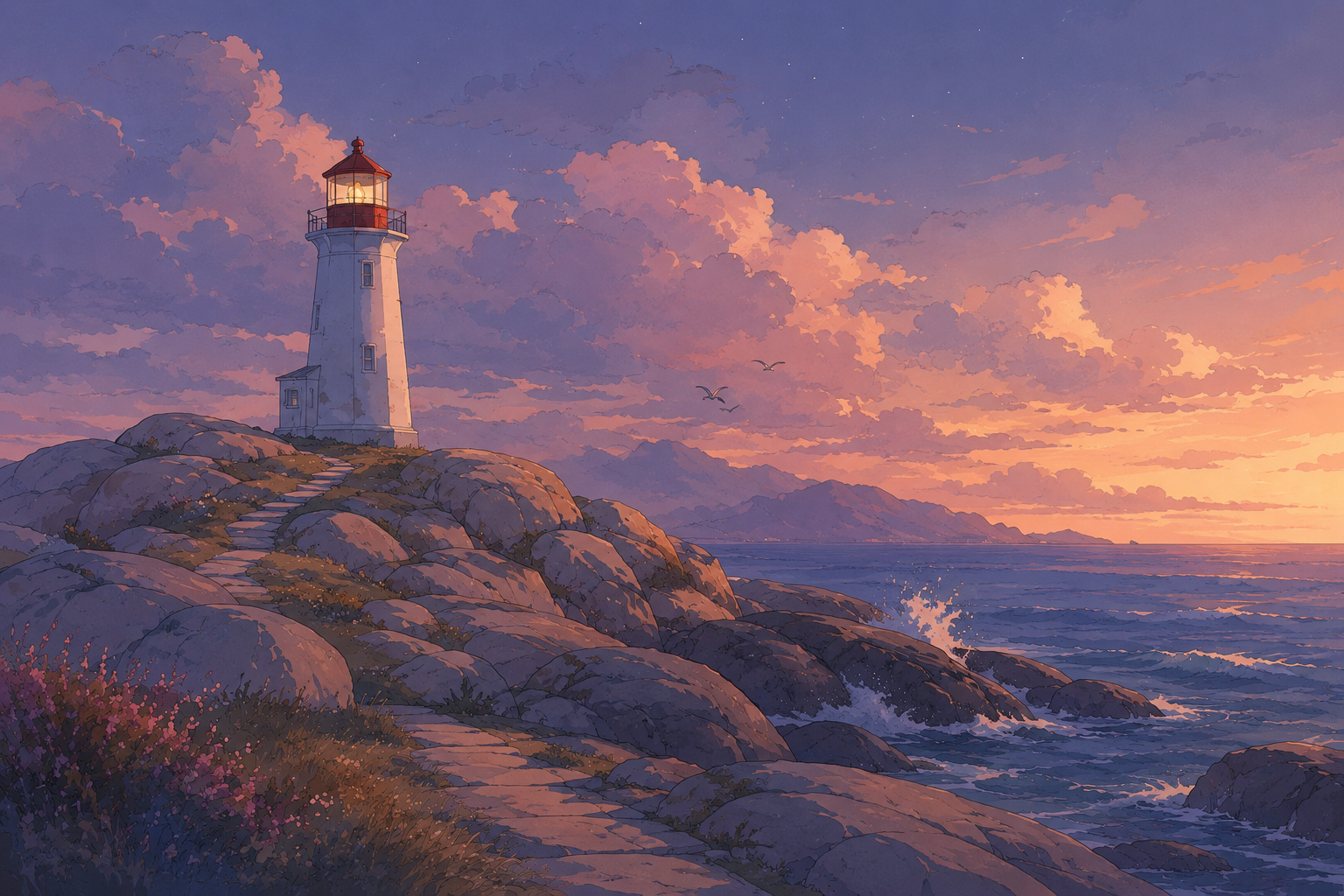
Lighthouses seem simple from a distance: a lonely tower, a glowing lantern and an endless stretch of sea. Yet behind that familiar silhouette lies a world of ancient engineering, secret light patterns, dangerous construction projects and remarkably dedicated keepers.
Here are twelve fascinating facts that may change the way you look at these guardians of the coast.
1. One lighthouse was an ancient wonder
The Lighthouse of Alexandria was built on the Egyptian island of Pharos during the third century BC. Rising more than 120 metres according to historical estimates, it was one of the Seven Wonders of the Ancient World.
For centuries, its fire guided ships towards Alexandria’s busy harbour. Earthquakes eventually destroyed the structure, but archaeological remains have been discovered beneath the water. UNESCO describes the ancient lighthouse as one of the most celebrated structures of antiquity.
2. A Roman lighthouse is still working
The Tower of Hercules in north-western Spain has guided sailors since the late first century AD. It is the only fully preserved Roman lighthouse still used for maritime signalling.
The exterior was restored during the eighteenth century, but the ancient Roman core survives inside. In 2009, the tower became a UNESCO World Heritage Site.
Nearly two thousand years of service is not a bad record for a building exposed to Atlantic weather.
3. One famous lighthouse stands on a rock that disappears underwater
Scotland’s Bell Rock Lighthouse was built on a reef that is visible only at low tide. At high tide, the rock can be submerged beneath approximately five metres of water.
Completed in 1811, Bell Rock is considered the world’s oldest working sea-washed lighthouse. Its builders could work on the rock for only a few hours at a time before the returning sea forced them to leave.
4. Lighthouse flashes are a form of identification
A lighthouse does not simply flash at random. Its sequence of flashes and pauses is known as its characteristic.
Neighbouring lighthouses normally use different characteristics, allowing sailors to identify exactly which light they are observing. One may produce two flashes every ten seconds, while another may show a single long flash followed by a longer period of darkness.
In other words, a lighthouse introduces itself without saying a word.
5. Their painted patterns also carry information
The stripes, diamonds and contrasting colours painted on lighthouse towers are not merely decorative. They are called daymarks and help mariners identify a lighthouse during daylight.
A white lighthouse may stand out clearly against dark woodland, while red-and-white stripes remain visible against pale cliffs or a cloudy horizon. Trinity House explains that both colour and shape are chosen partly to make each structure recognizable from the sea.
6. The Fresnel lens revolutionized lighthouse technology
Introduced by French physicist Augustin-Jean Fresnel in 1822, the Fresnel lens uses carefully arranged glass prisms to collect scattered light and focus it into a powerful beam.
The lens resembles a giant glass beehive. Its design allowed a relatively small lamp to produce a light visible many kilometres away. According to the US National Park Service, a Fresnel lens could direct far more of a lamp’s light towards the horizon than older reflector systems.
Some first-order Fresnel lenses were taller than a person and contained more than a thousand individual prisms.
7. Rotating lighthouse lenses were giant clockwork machines
Before electric motors, many rotating lighthouse lenses were moved by clockwork mechanisms. Heavy weights slowly descended inside the tower, turning gears that rotated the lens.
Just like an enormous grandfather clock, the mechanism had to be wound regularly. At Cape Hatteras, the keeper manually rewound the clockwork apparatus every day. Modern machinery has made the job easier, although perhaps a little less romantic.
8. Lighthouse keepers were sometimes called “wickies”
Keeping a lighthouse operating involved far more than lighting a lamp at sunset.
Keepers carried fuel upstairs, cleaned windows and lenses, polished metalwork, recorded weather conditions and repaired buildings damaged by salt and storms. Lamp wicks had to be trimmed regularly to prevent smoke from blackening the lens.
At Cape Lookout, keepers trimmed the wicks every four hours, helping to earn lighthouse keepers the nickname “wickies.” The National Park Service’s account of keeper life shows just how demanding and repetitive the work could be.
9. A taller lighthouse is not always better
The higher a light stands above the water, the farther it can theoretically be seen because of the curvature of the Earth. However, putting a light too high can create another problem: nearby sailors may pass beneath the main beam.
This is why a lighthouse built on top of a high cliff may have a short tower, while one beside a low beach may need to be much taller. Its location matters just as much as its height.
10. An enormous lighthouse once went for a walk
By the late twentieth century, coastal erosion threatened the Cape Hatteras Lighthouse in North Carolina. Instead of abandoning it, engineers moved the entire 4,830-ton brick structure.
In 1999, hydraulic jacks pushed the lighthouse along steel tracks in increments of about five feet. The journey covered 2,900 feet—or approximately 884 metres—and took 23 days. Sixty sensors monitored the tower throughout the move.
The National Park Service recorded the remarkable relocation, which returned the lighthouse to roughly its original distance from the ocean.
11. Powerful waves can make a stone lighthouse tremble
Rock lighthouses are designed to withstand astonishing forces. During a study of England’s Eddystone Lighthouse, instruments recorded thousands of movements caused by winter storms.
Some wave impacts produced accelerations comparable to those experienced during earthquakes. However, the actual movement of the tower remained smaller than a fraction of a millimetre. The results showed just how effectively nineteenth-century engineers designed these structures to resist sliding, overturning and material failure. Trinity House describes the study here.
12. Halifax has a lighthouse in the middle of its harbour
Nova Scotia’s connection with lighthouses extends far beyond the famous tower at Peggy’s Cove. Georges Island, located directly in the middle of Halifax Harbour, has its own lighthouse overlooking passing boats and the city waterfront.
The island is accessible only by sea and also contains the remains of Fort Charlotte, part of Halifax’s historic defence system. Today, visitors can reach Georges Island National Historic Site by ferry or private boat.
More than a light beside the sea
Modern navigation relies heavily on GPS, radar and electronic charts, and many working lighthouses are now automated. Nevertheless, their purpose remains unchanged: to warn, guide and reassure.
Perhaps that is why lighthouses continue to hold such a strong place in our imagination. They represent safety without noise, strength without aggression and hope that remains visible even when everything around it is dark.